

Share This Article
Food inflation is at historic lows, but coffee drinkers are still paying more for their daily cup
The first day of October marks International Coffee Day, a global celebration of the drink that keeps the world buzzing. Eighty20, South Africa’s leading consumer strategy, research and analytics company, looks at what South Africans are paying for coffee, how much they are drinking and which brands are winning with customers.
Despite significant inflation in the price of fuel, the grocery basket has cooled significantly this year. Headline consumer inflation was 4.4% in August 2026, and annual food and non-alcoholic beverages inflation was just 1.1% in August, one of the lowest readings in over a decade. The bad news for coffee lovers is that their cup has not followed suit. With Instant Coffee sitting at 5.6% YoY inflation in the latest CPI data. In fact, Instant Coffee has gone up 57% since mid-2022, and Cappuccino (sachets) up 24.4% over the same period.
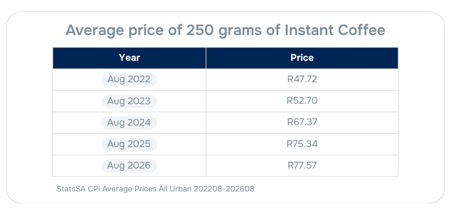
That is very different from the 22.3% YoY spike in instant coffee prices recorded in August 2024, but prices are still rising well ahead of CPI and the rest of the food basket. Stats SA no longer tracks ground coffee and beans in its basket, so instant coffee remains our best measure of what households are paying.
“Coffee has stayed stubbornly expensive while the rest of the food basket has cooled, yet consumption is holding up, and a record global harvest could bring relief next year,” says Andrew Fulton, Director at Eighty20.
Global pressures remain, and coffee prices on world markets remain highly volatile. The USDA forecasts global coffee production to rise by 6% to a record 189.7 million bags in 2026/27, with strong harvests expected to create a substantial supply surplus. If that surplus materialises, South African shelf prices could finally begin to ease in 2027.
How is that impacting substitute warm beverages that get you going in the morning, and over that mid-afternoon hump? The price of Ceylon tea has gone up 41% since mid-2022, and rooibos tea up a more manageable 21% over the same period. Both are still above CPI, but not experiencing the steep price increases of coffee.
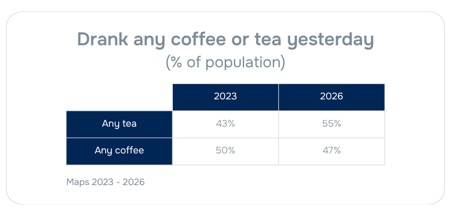
The MAPS data, a quarterly dataset released by the MRF, suggests that coffee drinkers have reacted more to price increases, while tea drinkers have grown over the same period (the MAPS data did not include some tea categories in 2022, so we compared against 2023 instead). About 26 million South Africans drank some form of tea (Ceylon, Rooibos, Green) yesterday, while 22 million drank some form of coffee (Pods, Ground Beans, Instant Coffee, Instant Cappuccino). What these high-level figures do not reflect is how many cups of each beverage are consumed in a day.
Globally, coffee consumption is forecast to reach a record 179.7 million bags, with consumption of 42.5 million bags in the European Union, 26.95 million in the United States and 6.75 million in China rounding out the top 3 consumer areas. That is roughly 10.8 million tonnes of coffee. South Africa consumes closer to half a million bags of coffee in any given year.
Eighty20’s National Segmentation (ENS) divides South Africa’s adult population into 8 segments and 46 sub-segments. The ENS sheds some light on coffee preferences by segment, showing ground coffee remains firmly a wealthier household habit, while students lean towards instant cappuccino. The Middle Class and affluent Heavy Hitters segments represent just 15% of adults but account for 22% of the roughly 2.4 million ground coffee drinkers nationwide. They are not as partial to Ricoffy however, making up less than 13% of the more than 11m people who drank South Africa’s ubiquitous Chicory offering yesterday.
BrandMapp data shows where South Africans go when they head out for coffee, with Mugg & Bean the most likely venue, with a third of those in households earning more than R10,000 per month visiting regularly, followed by Seattle, Woolworths, and Vida.