
Share This Article
What if the future of skincare isn’t about trying to make your skin look younger, but helping it age exceptionally well? That is the thinking behind Lamelle RFM – a sophisticated approach to skin ageing built around one of the most intriguing developments in regenerative skincare: Stem Cell Conditioned Media (SCCM). The name may sound like something that belongs in a medical textbook rather than your bathroom cabinet, so let’s simplify it.
Think of SCCM as the liquid essence of a stem cell.
Not the stem cell itself, but the biologically active substances released by stem cells while they are in culture. This “conditioned media” can contain a complex mixture of growth factors, cytokines, signalling molecules and other bioactive components. Researchers are investigating how these substances can influence processes involved in skin repair, regeneration, and ageing. In other words, the science isn’t simply about putting something on your skin.
It is about giving skin some of the signals associated with repair and renewal. So, what exactly is the big deal? Our skin is remarkably clever. It is constantly repairing itself, communicating between cells and responding to everything from UV exposure and pollution to stress and the natural ageing process. But as we age, some of these biological processes become less efficient.
Collagen production declines. The dermal structure changes. Cell turnover slows and the skin’s ability to maintain its youthful architecture is gradually reduced. Both chronological ageing and environmental exposure contribute to these changes. This is where the concept of regenerative skincare becomes particularly interesting.
Rather than simply trying to make the surface of the skin look smoother, researchers are exploring ingredients and technologies that can support the biological processes underneath that appearance. Stem cell conditioned media research has identified growth factors and signalling molecules that may influence fibroblasts, keratinocytes, extracellular matrix production, inflammation, and tissue repair. And that brings us to RFM.
RFM: A Different Approach to Ageing
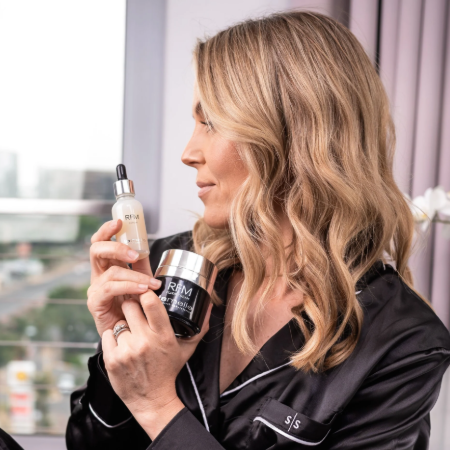
RFM is special because it incorporates Stem Cell Conditioned Media, bringing this regenerative science into a sophisticated skincare approach. The goal isn’t to promise that you can stop time. Spoiler alert: you can’t. The goal is much more realistic and arguably much more desirable.
To help your skin maintain its ability to function, repair, and renew as it ages. Think of it as moving away from the traditional “anti-ageing” mindset and towards ageing well.
Because ageing skin isn’t bad skin. It is skin that has lived. Sun exposure, facial expressions, hormones, stress, lifestyle and simply getting older all leave their fingerprints behind. The objective isn’t necessarily to erase every one of them. It is to support the skin so that it remains resilient, healthy-looking, and structurally supported for as long as possible.
One of the most fascinating aspects of conditioned media is that it isn’t one single ingredient doing one single job. The stem cell conditioned media is a collection of signalling molecules. Reviews describe components including growth factors, cytokines, extracellular vesicles and other bioactive substances that can communicate with cells and influence processes such as proliferation, migration, inflammation, and extracellular matrix remodelling.
Imagine your skin as a construction site.
Collagen, elastin, and other components provide the building materials. Cells are the workforce. Signalling molecules are some of the instructions saying that workforce what needs to happen.
As we age, those instructions may become less effective. SCCM is interesting because it provides a sophisticated collection of biological signals rather than relying on one isolated “hero” ingredient. That is the science behind the excitement.
What Does This Mean for Your Skin?
Research into stem cell stem cell conditioned media and conditioned media has explored their potential role in skin rejuvenation, including effects related to wrinkles, pigmentation, texture, elasticity, and skin regeneration. Clinical research is still developing, and results depend on the source of the conditioned media, formulation, concentration, and delivery method. A systematic review of topical growth-factor preparations found evidence of modest improvements in skin texture and fine lines, while also highlighting the significant variation between formulations and studies. But that is precisely what makes the science so fascinating. This isn’t a magic wand. It is an evolving area of regenerative skincare that is looking at ageing from a fundamentally different perspective.
Ageing Well Is the New Anti-Ageing
Perhaps the most interesting part of RFM is the philosophy behind it. We have spent decades being told to “fight” ageing. Fight wrinkles. Fight pigmentation. Fight loss of firmness. Fight every visible sign that we’ve had the audacity to get older. But perhaps we should be looking at it differently. Ageing well means supporting your skin before it becomes completely overwhelmed. It means protecting against photo-ageing. Supporting the skin barrier. Using evidence-based actives.